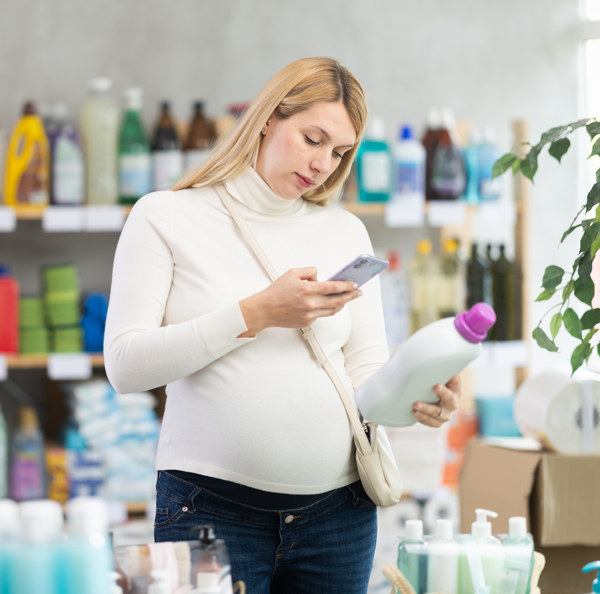
Most household products hide what is really inside them behind words like "natural" and "fragrance." We help you read past the marketing, cut your family's exposure to toxic ingredients, and buy direct from a U.S. manufacturer with nothing to hide.
"Natural." "Green." "Gentle." "Fragrance." Not one of those words is regulated, and not one of them tells you what is actually in the bottle you just put in your cart. An educated shopper stops buying the front of the package and starts reading the back.
We do that reading for you. Every product we carry is vetted ingredient by ingredient against published toxicology research, so a five second decision at checkout is backed by hours of work you never have to do yourself.
Then we show you exactly what we found. Full disclosure on what is in each formula and, just as importantly, on what we deliberately left out. No proprietary blends, no hidden fragrance list, no asking you to take our word for it.
These are not scare tactics. They are peer reviewed findings, and knowing them is the first step to reducing what your household absorbs every day.
Conventional cleaners, synthetic fragrances, and off-gassing from household materials continuously degrade the air quality inside the home, where families spend up to 90% of their time.
Over 280 industrial chemicals, including flame retardants, pesticides, and consumer product ingredients, have been found in the cord blood of newborns, passing from mother to baby before birth.
More than 90% of cancer cases are linked to environmental and behavioral factors, and many of the most common carcinogens hide in everyday household products and personal care items used without a second thought.
From surfactants to solvents, the products stored under the average sink and on the average laundry shelf introduce dozens of synthetic compounds into the home, most of them never listed by name on the label.
Parabens mimic estrogen in the body and are used as preservatives in lotions, shampoos, and cosmetics. Their direct presence in breast tumor tissue has drawn serious concern from cancer researchers worldwide.
The desire to switch to healthier products is widespread, but ingredient lists are confusing and label claims are unregulated. Knowing what to look for is the difference between hoping a product is safe and knowing it is.
Send us the products you are buying now. We will walk the labels with you line by line, show you which ingredients are worth avoiding, and tell you what a lower exposure swap would actually cost.
Takes about 15 minutes. No pressure, no scripts.
We were making products this way long before "clean" became a marketing word. The principles are older than the trend, and they have not moved since.
Our formulas come from practicing physicians and PhD-level scientists, not from a marketing department. There is a difference, and you can read it on the label.
Every product is made in the United States in facilities we control, under strict quality standards. We know exactly what goes in, and exactly what stays out.
We sell straight to you. No shelf fees and no distributor margin, so the money goes into ingredient quality instead of into a supply chain.
Buying from a U.S.-based manufacturer is not a slogan for us. It is the reason we can answer your questions. When a product is made overseas by a contract facility three suppliers deep, nobody in that chain can tell you with certainty what is really in it. We can, because we make it ourselves.
Domestic manufacturing also means shorter supply lines, tighter quality control, American jobs, and formulas that answer to U.S. safety standards at every step of production rather than only at the border. Because we sell direct and operate online, we remove every layer of retail markup and put those savings back into purity and into your household budget.
Want to see the actual ingredient list?
Ask us for it. Our advisors are real people, not chatbots and not scripts, and they will send you the full formula sheet for anything you are considering before you spend a single dollar.
You have already been reading labels. You have already been searching ingredient names late at night. There is a simpler way to do this, and thousands of households have already found it.